It’s been a while…
- At March 05, 2013
- By mitch
- In Uncategorized
 0
0
Hi there friends,
We know it has been a while since our last post, but don’t worry we’re back! It is currently the high season here at Finca Bona Fide which means a lot volunteers and a bunch of great projects. Starting today the community here at the finca is going to be actively updating the Bona Fide blog with farm updates, intern project updates and volunteer views. We hope this will be a useful tool for all of you wondering what happens here on a daily basis. In the meantime here is a great picture of Volcán Concepción. Stay tuned for some Bona Fide posts!
– Andrew

Bona Fide Garden Update!
- At August 17, 2012
- By mitch
- In Farm
- 0

Hello friends of Bona Fide,
This rainy season is seeing lots of growth (very literally!) on the farm, as we continue to develop our plant, animal, social, and various structural systems. I’ve had the incredible opportunity of learning about these reticulated systems through hands-on work, observation, and research in the months since I took the permaculture design course on the farm this past February. As I’ve spent the past five months working primarily in the annual and perennial kitchen gardens, I’d love to give everyone an update on what we’ve been working on in these gardens.
When I first arrived on the farm in early February, we were beginning to redesign the three-terrace gardens located right next to our kitchen, and to think about expanding some of the perennial areas behind the medicinal garden. Though the three terraces thrive in the wet season, in the dry season these areas are exposed to brutal heat and strong winds that sweep up the side of the mountain. The garden location is ideal in it’s accessibility from the kitchen, but these other factors led us to discuss the possibility of moving the kitchen gardens completely. After hours of mapping the areas (making use of skills mastered in the permaculture course!) and debating, we came up with a design. We decided to keep the first two terraces in production, using shade structures on each level for protection from dry season desiccation, and to use the least protected third terrace for our new clothesline area, along with our 3-pile compost system and our most drought tolerant, resilient annual crops. We redesigned the beds on the second level, making better use of space, improving accessibility, and making plans for constructing semi-permanent beds. At the same time, we made plans to expand in the more protected perennial garden areas.

First terrace garden with shade structure and new permanent beds, at the tail end of the dry season. We use the white buckets on the right for mixing up organic pesticides and pest repellants.

The new clotheslines basking in the heat of midday sun!
My first couple months of work primarily involved construction—of the clotheslines on the third terrace, and the beds on the second terrace. Hector and I worked with any volunteers willing to wield the pickax, constructing beds with brick and cement at first, and then making use of scrap materials to put together semi-permanent beds. We ended up using old roofing tiles, a big improvement on the previous wooden beds which were breaking down in no time!
In April we hired the help of Juan, a local experienced in organic agriculture, who had been volunteering his time to work on the gardens at the Mano Amiga community center. It was great to be able to learn from Juan and to ask him my questions every day, instead of constantly making notes of plants to research, or running around the farm looking for Mitch. Juan continues to work mornings at the finca, and volunteer at the Mano Amiga gardens in the afternoons. Working with Juan, and often with help from the many student groups we have passing through, we constructed a bamboo arbor over four beds on the second terrace, and set up trellises running up from the second to the first level. These structures allow us to make optimal use of vertical space, and the arbor will provide some shade and wind protection for the coming dry season.

Juan gives an explanation next to our seedling nursery. We start many plants in the nursery due to problems with germination and to keep closer tabs on which varieties succeed.

Bamboo arbor frame, over the beds constructed with roofing tiles and rocks.

Yardlong beans begin to climb the structure.
The rains first started sporadically in mid-May and suddenly the farm was a jungle of radiant color and buzzing swarms of new insects. Everyone who has experienced this change in season on the farm knows how incredible this transformation is, and we no longer had to stand around watering the gardens for over an hour! We began planting like crazy, both in the kitchen gardens and all over the finca, and also started looking into implementing plans for expansion in the perennial area. Not an insignificant part of this task was simply clearing out the area; once the rain begins paths become overgrown in a matter of days, and accessibility to garden areas is very important as we want to encourage everyone to explore and harvest food. Mo, an agriculture student who worked with us for two months, led the perennial garden project, making adjustments to the original design as we ran into some problems (hitting the underground water pipes). She built new beds, prepped and planted existing beds, and put together a stone bench in what had become a relaxing butterfly garden.

Second Terrace of the gardens at the beginning of the rainy season.

Experiments in okra perennialization.
Of course, the best part of working in the garden is harvesting food! We make an effort to use the abundance of fruits, veggies, and herbs we grow for food and medicinal use, and to educate incoming volunteers on what they can use, where to find it, and how it can be prepared. We currently have a large variety growing in the gardens, including many different types of asian greens, arugula, various leaf lettuces, indian lettuce, okinawa and malibar spinach, collard greens, kale, beets, cucumbers, squash, watermelon, several types of beans including mung and yardlong, basil, okra, cilantro, dill, fennel, tomatoes, sweet and hot peppers, and amaranth growing in our annual garden beds. These crops, in addition to all the incredible fruit and perennial vegetables found on the farm, leave us nearly unlimited possibilities for creating fresh, nutritious meals.

Okra is a very successful crop on the farm.

Yardlong beans are highly prolific, delicious, and climbers that utilize vertical space. Though we get many seeds from northern temperate zones, the crops that do best are usually those either produced on the island or native to analogous climates, such as southeast Asia.

Pickled Beans!
Thank you all for your interest and support, it is greatly appreciated.
~Berkley Heath~
Permutation
- At May 10, 2012
- By mitch
- In Farm
- 0
There’s nothing like hopping on a plane, sitting for a few hours in mid-air and BAM stumbling off in a new country a thousand miles away that can make one realize how small the world is and how much it has morphed and is morphing. In the matter of a day, I transplanted myself from the cosmopolitan sprawl of Houston, Texas to the beautiful, slow and mysterious island known as Ometepe.

The farm view of an Ometepe sunset.
PDC
It didn’t take long to realize as the new Volunteer Coordinator just how much really goes on in this unique place. When I first arrived in February, I was able to catch a glimpse of Project Bona Fide’s Permaculture Design Course that took place right here on the farm. An influx of over 50 budding permaculturists from all ages, backgrounds and parts of the world came to listen, design, and learn from the impressive likes of Chris Shanks, Michael Judd, Jackie Pitts, Doug Bullock and Dave Boehnlein. Over the course of these two weeks, they walked properties, discussed plans, made kimchi, grafted, and presented designs of their own permaculture farms leaving with a transformed perspective and an excitement/exhaustion that only two intense weeks of learning in a place like this can bring.

Doug Bullock in front of the class.
Volunteers
And it didn’t really slow down after that. In these last few months, the farm has been anything but static. With volunteers constantly coming and going, the feel of the farm can shift from a buzzing business to a quieter determinedness. The farm has had anywhere from less than ten to almost thirty volunteers staying with us at any one time. And it’s with much gratitude that I’ve been able to see the hard work, time, energy, love, and support of our over 50 volunteers from all parts of the world. I can’t say how appreciative I am for the growth and impact they have had on me, the farm, and the island. So thank you ALL and please make your way back!

Andrea and Leandra ready to process some Jackfruit.
We are also thankful for the return of Greg Courmier with a group of students from West Vancouver High. For the past five years, Greg has been bringing groups of students to experience life here in Balgue. Between their homestays, workshops, and work in the community and on the farm, this group has left lasting impressions here. We are thankful for their time and hope to see them again in the near future.
They were shortly followed by students from the LEAPNOW One Revolution gap year program. They spent their week here in Balgue, learning about permaculture, Nicaraguan history, and life on the island. They danced, baked, dug, and practiced their spanish over a jammed packed week of new experiences. Thanks again, happy travels, and hope to see you again.
The Farm
And all the while, we have watched and worked on a variety of projects completed and ongoing, transforming piece by piece, plant by plant, person by person the look and feel of this farm.

Taking a break from work.
We’ve completely redone our three terraced Volunteer Garden. In January, on our first terrace, we constructed more permanent raised beds with a shade structure to keep the sun from frying more sensitive plants. We are currently in the process of redoing the design and beds on our second terrace using all recycled materials, and have taken advantage of the full sun and wind of the third terrace to put up our new clothesline.

The new shade structure over the first terrace.

The new completed Chicken Coop.
Chickens are now running around, pecking, scratching, and laying eggs here on the farm. Our chicken coop was completed here in February and nine happy chickens have moved in with lots of space for more. Besides laying eggs for us, they help us deal with the vast amounts of termites on the farm. Turns out termites are quite a tasty and entertaining treat to the chickens.

Construction on our new fire wood shelter is nearing its end.Complete with a stone floor, this structure should give us the space necessary to store and keep dry all the fire wood we’ll need for the soon to be rainy season.
- Progress being made on our new fire wood structure.
Given the go ahead to turn our “Aula” into a communal space, volunteers have taken on the initiative to change the feel and look of this awesome building. Hammocks and volunteer constructed furniture will add a more laid-back feel to the new ceramic tile floor that should be put down within the next few weeks.
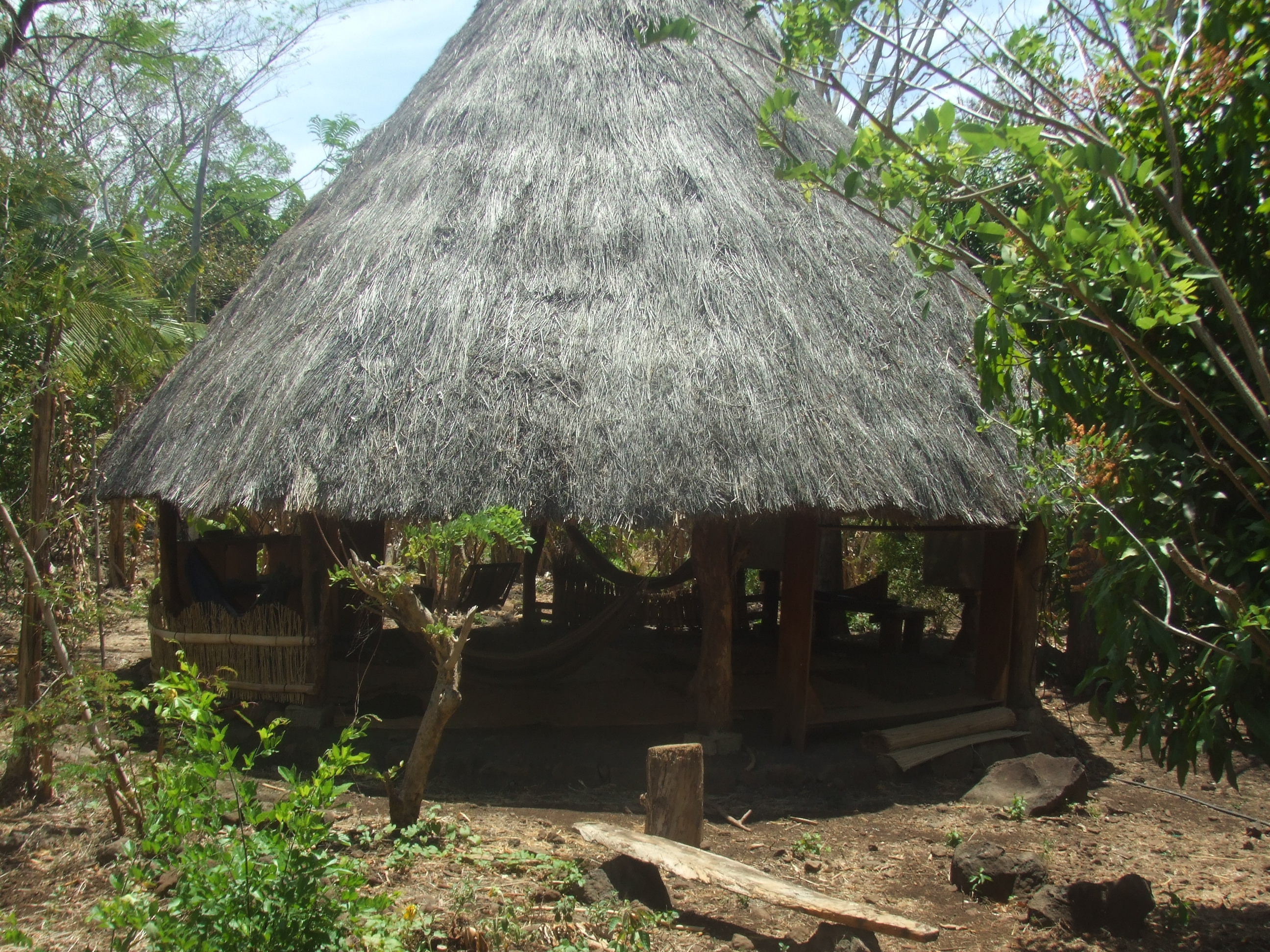
The Aula before renovations begin.
And at last, a new Royal Palm roof! Our old roof has given us five good years, but work is about to begin to replace it. The replacing of the roof is also allowing us to redesign the setup of our kitchen, too. We’ll make sure to pass on pictures once it’s completed!

The kitchen waiting for its new roof!
The farm has also added two future guard dogs, Noor and Lilah. This cute brother and sister combo has added lots of life and energy to the already bustling farm. They’re still learning the role of guard but it’s hard to be unforgiving once you see them.

Noor and Lilah lounging.
Project Mano Amiga
And our work goes way beyond the barb wire borders of our farm. For the local community center, Kim, our Community Coordinator, along with some other volunteers have helped raise over $7000 to fund the construction of a new space (designed by farm interns Maria and Marco) devoted to the community’s sewing co-op . Thanks to the support of friends, family and benefactors all over the world, this awesome group of women will soon have an area to expand their growing sewing business. Construction will be starting soon.

Kim in sewing class with some of the women.
Further, we’ve started a garden intern program with Mano Amiga. Four times a week we send down volunteers to help grow and maintain their garden. With the supervision of Juan Gonzalez, a native from Balgue with over ten years of experience working on organic farms across Nicaragua, the community garden has turned from a space over grown with weeds to beautiful beds full of beets, beans, peppers, cucumbers, squash, and more.
Intercambio de Semillas
And coming up at the end of April, we are having our bi-yearly, seed exchange, Intercambio de Semillas. This year we plan to have over 50 varieties of tropical trees and shrubs, medicinal plants, native and exotic fruit, and edible perennials to share with anyone willing to trade. With the inclusion of workshops and vendors, we forsee this being our largest exchange ever with Nicaraguans and ex-pats from all over the island coming to trade seed and share genetic diversity for the mutual benefit of all involved.

Mitch sharing some of our gandul harvest with Juan.
And as I try to make sense of the vast and varied changes taking place on the farm and in the community, I can’t think of a better word to describe it all than PERMUTATION. Here in these four months, I’ve watched the ideas of permaculture and permaculturists transform the land and people involved with it. It’s hard to walk around and not be impressed by the real alchemy of seeds into full fruiting trees, a foundation into a solid structure, a barren patch of pasture into a forest of food, and a hodge podge of travelers and locals into a community. All the while experiencing in myself and those around me some awesome shifts in thought about farming, living, community and our own place in the world. This piece of land and I have successfully been permutated and I hope that the others who pass through and have passed through get to experience this same change.
And, now, only as I’m starting to get comfortable in the routine of dry season am I beginning to notice more clouds rolling in and more bugs swarming around, volunteers leaving and more coming in, projects ending and focuses shifting, all the tell-tale signs of the impending rainy season. And I can’t help but looking forward to more of the same.
Sincerely,
Tom Garcia-Prats
Goodbyes and Congratulations
P.S. One last special thanks to Liz and Jim and congrats to Mitch
Liz was the Volunteer Coordinator for the Project the 6 months prior to my arrival. Besides the huge amount of time spent helping manage the day to day tasks of farm life, she designed and help build our very own chicken coop that now houses our first batch of laying hens!! She’s back in the states getting ready for law school.

Liz cuddling Noor and Lilah.
Jim spent close to a year on the farm working on probably every project and farm task in some way but most notably with the jackfruit, hence his nick name Jackfruit Jim (see last Post) His presence, knowledge, and energy was an awesome resource to the farm and volunteers. He’s left us for the colder shores of Orcas Island, working at the Bullocks Brothers’ homestead.

Jim hanging out in the hammock.
In January, Michael and Chris added on Mitch Haddad as an additional Co-Director. With the dramatic growth of the farm and volunteer program over the past year, Mitch has been brought on to help support and expand the development of both. Having spent the last two and a half years working in Nicaragua with a variety of NGOs (including the last year and a half here at Bona Fide), Mitch was the perfect candidate having experience in community activism and organizing, sustainable construction and farming, and a resourcefulness and drive endemic of the Nicaraguans here on the island. Already, many of the projects completed so far this year are thanks to his extra support, guidance, and presence on the farm. Congrats to him.

New Co-Director, Mitch Haddad, teaching in the Aula.
Recent Comments