Collective Inertia
- At November 22, 2013
- By Coordinator
- In Farm, Projects
 0
0
A lot has happened here on the farm since we’ve last updated. No matter how much I say that I’m really going to do it this time and keep the blog updated, it continues to be exceedingly difficult to sit down for long enough to type down an entry. A farm is a living organism, and like any organism has many needs which at times need to be cared for. Chickens get sick. Horses sneak onto the property and chow down on precious, unique plants. Rain storms come when all the grains are out in the sun. Somehow there’s always something. Personally, It’s part of what I love about farming, there’s constant problem solving to be done.
Recently I took a spin around Nicaragua and met up with people around the country looking to promote our tours and courses and network for some possible future partnerships. The breadth of social, environmental, and agricultural projects out there and the passion of all of the people involved in them really sent me back home to Bona Fide feeling inspired. One of the things that repeatedly surprises me is how much a few people can do when their hearts are in it and when a few good minds get together.
Interested in a bit of what I saw? Check out
Sonati – a great example of social enterprise eco-business for environmental youth education
La Isla Foundation – doing amazing work promoting conscientious tourism and simultaneously funding research into daunting health problems in cane workers in Latin America
Opportunity International Nicaragua – straightforward and effective volunteer driven agricultural education for small communities
Organizations like these reminded me of exactly what about Bona Fide that I fell in love with when I first came here, that this little piece of land in this unique place could be a meeting place for so many people trying to live intentionally, to improve our collective human experience, and to learn along the way. The longer I’m here and the more people that I see come through, the more I feel the momentum building, One short term volunteer, one student group, one intern, one concerted effort at a time this place keeps growing, the problems get solved, and the little gaps in our closed loop systems are sealed.
The first Carpe Diem and Leap Now gap-year travel groups put in months of man-hours in little more than three weeks. They helped dig hundreds of feet of swales, volando machete (clearing weeds) with volunteers and I out in the hot sun. But don’t worry, it wasn’t all forced labor, they also got a great learning experience with basket making, chocolate making, nacatamale cooking and dance workshops, as well as a three day yoga retreat with the masterful Danae. Check out the groups’ blogs about their experiences here.
We’ve seen a pretty good rainy season on the island. It’s been persistent but rarely heavy enough to cause any real damage. It made for a good rice harvest, something that the second of the Carpe Diem student groups had the chance to join in.
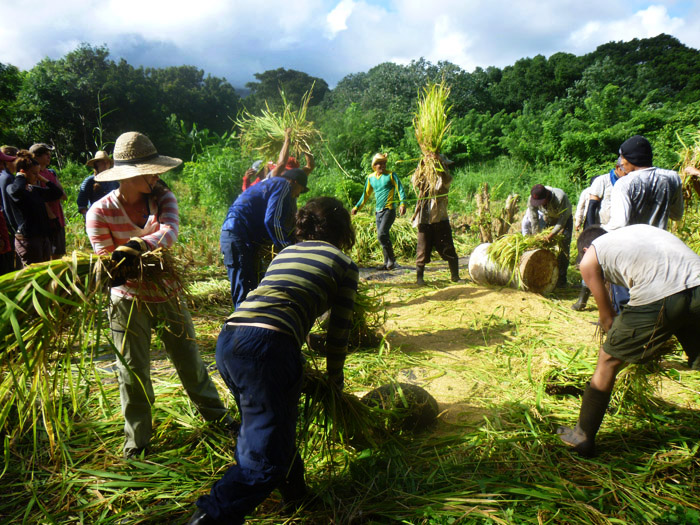
I heard a couple of the Nicaraguan workers make remarks about how quickly we could cut a field with thirty something people.
The students, on the other hand, left amazed by the experience of seeing where something that seems so basic really comes from.
Peter, an exceedingly handy long term volunteer of ours, lead them in putting in some new paths with broken bricks we had laying around. Then they helped out carrying a bunch more faulty bricks from a local brick maker up the hill.
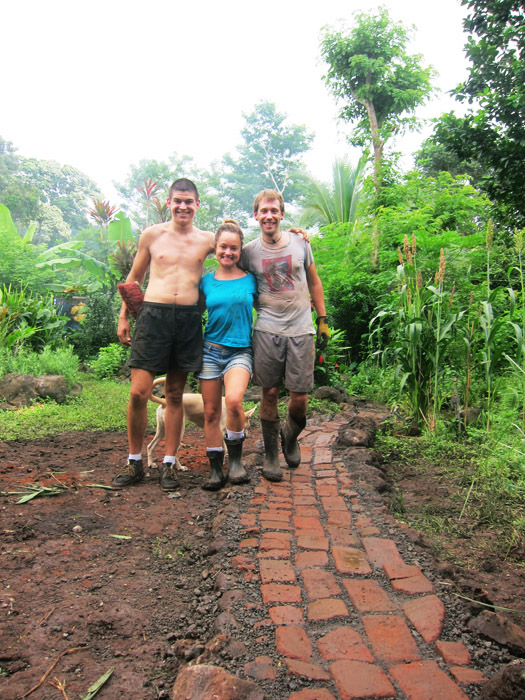
Look how happy Felix, Melissa and Peter are walking with dry feet over all that mud.
What mud? Right when I was starting to think the whole farm was just going to sink into the damp earth like a biodegradable Atlantis, the wind shifted to the Northeast, the ants started to swarm again, the bees came out, the quebradas slowed down, and the rain stopped. Now the many challenges of the dry season in the semi-arid tropics loom ahead. For many families on Ometepe and around Nicaragua, how they choose to contend with them will determine what they eat and how they live for the next sixth months. Let’s see what solutions all these good heads, hands, and hearts, can come up with.
Tropical Bat Houses
- At June 28, 2013
- By mitch
- In Projects
- 0
– By Meredith Van Acker
During my time interning at Finca Bona Fide I was involved with constructing and erecting bat houses.
The Role of Bats:
There are many benefits from the presence of bats in the natural world, especially on a permaculture farm. Insectivorous bats play an active role in determining how many (potentially damaging) pests are in the air and on the ground. Consequently, bats can help farmers with plant growth and health through this natural pest management. Nectar-feeding bats are critical pollinators for many plants, such as agave and giant cacti, and also improve genetic diversity through cross- pollination of plants. Also, fruit-eating bats can aid in reforestation through seed dispersal. In addition, a useful product that can result from bat house construction is bat guano. Bat guano provides a high concentration of nutrients to plants and the surrounding soil due to its high levels of nitrogen and phosphorus. The guano can be used or sold as fertilizer to surrounding farms and community members.
The Role of the Bat Houses
The bat houses serve multiple purposes for the farm and the bats including:
– Safe roosting sites for the bats.
– Integrated pest management practices for the farm systems.
– Guano harvesting for the fertilization of farm soil.
All of these factors had to be considered in determining the best placement for the houses. To meet roosting preferences for the bats we ensured the houses received 6-8 hours of sunlight daily in an open space with a large swoop zone and as far away from potential predator perches (other trees and structures) as possible. We also placed the houses close to areas of high existing bat activity and food sources.
Integrated pest management is an environmentally sensitive approach to managing insects that works towards the least possible impact on people, the property and the surrounding environment. It uses information on the life cycle of pests and their relationship with their environment for the appropriate management of insects. Therefore, in order for the bats to interrupt the life cycle of pests the houses were placed near water sources on the farm that become sites for hatching insects.
The Construction of the Bat Houses:
We used local cedar which is naturally resistant to insects and decay and treated it with linseed oil for natural weather resistance. The first house had three chambers with grooved chamber partitions for the bats to hang inside the house.
For the last two houses, we ripped the wood in order to create thinner and lighter boards. This was a labor intensive and time-consuming process, as it had to be done almost entirely with a handsaw. Needless to say we improved our upper body strength significantly:) Moreover, the new design resulted in less wasted material. With the lighter houses we were able to securely mount the houses to withstand against the strong winds and rain. The roofs have a three-inch overhang to protect the house during the rainy season as well. The roof shingles were made from collected aluminum cans from the volunteers and a local restaurant.

The picture below show the inside of the chambers.

The next big challenge was choosing a site on the farm to mount the houses. We decided to place two houses on one pole to increase the efficiency for guano harvesting in the future and save on the number of poles needed. The houses were mounted on logs that were at least 12 feet in height. We placed two houses back to back on one pole and the third (and heaviest) house on its own pole.
Two houses were placed in an open space near the Casa del Sol, a three bed volunteer housing structure. This structure was experiencing issues with bats flying above the beds at night and leaving droppings in the structure. For both bat houses to receive balanced sunlight, one house was placed facing south and the other faced north. A new channel was recently dug out in front of Casa del Sol to catch water during the rainy season and feed into the farm’s watering system. This was expected to bring an increase in insects in that area and is not preferred for the volunteer experience as well as for the health of the plants. Therefore, the increase of bats in the area would be highly beneficial.

The last house was placed across the pond from another volunteer housing structure, the Hilton. The house was placed with the entrance facing southwest over the open pond to catch optimal sunlight. The pond was dry when we put the house up because it was in the midst of the dry season. However, it fills up with water during the rainy season and becomes a problem area for insects. Therefore, this placement satisfies the main goals for the houses, ideal roosting conditions, meets integrated pest management concerns and offers a viable site for guano collection.
The project serves as an example of the ideals of permaculture, stacking functions within time and space. When we look at the design of a landscape the functions of each part should work within the whole system. And in permaculture it involves the human and ecological system in a way that meets the needs of the localized area as well as allows for the cycles to continue being productive and self-sustaining. Once the houses become occupied they will be an integral part to the ecological systems that are in place at Finca Bona Fide. They can serve as a link between the human constructed environment of the farm and the existing wildlife that creates the regions’ biodiversity.

If you have any questions, feel free to email me at mvanack@gmail.com!
Structures
- At April 20, 2013
- By Coordinator
- In Projects
- 0
One of the big things we talk about in permaculture is our structures – their relative location, how they utilize resources, and their integration into our systems. In the past few weeks here we’ve had an incredible amount of energy going into construction. It’s the dry season and the busy season, and so not only is it the only time of year when plasters and mortars have plenty of time to set, but it’s also when we have a lot of hands on deck for all of the labor that goes into putting up new structures and repairing the old. There have been tons of people here, two big groups of students and loads of short and long term volunteers, and all of them have made a big difference. There’s been a lot of hauling sand, cutting bamboo, stomping in clay pits, carrying tiles, and much more. Thanks to the high season we’ve really been able to get a lot done.

Paul and Charlie cutting straw for cob mix.
Paul and Vida are a couple with their own farm project in Argentina. They brought their natural building expertise here and lead the construction of new walls on one of our larger dormitories. They used a mortar mix made of clay, sand, and horse manure, along with cow enzymes to help harden and waterproof the mixture. First they put stem walls in place, fixing large stones with the mortar. On top of that they used our bottle bricks (PET bottles packed until rock hard with trash) supported with bamboo and covered them with mortar to create the wall. They used fermented nopal cactus juice in the rough coat over the wall to add water resistance, and borax to prevent insects from eating the bamboo. The new walls will make the dorms dryer during the rainy season and cooler during hot months.

Getting messy in the clay for cob
So, you might be asking yourself, great, Bona Fide looks prettier, but what does that have to do with the community of Balgue on Ometepe? There are a few different elements at play here, but the most obvious and direct is showing how natural building techniques can be used to create structures that are not just functional but also aesthetically pleasing. During the construction nearly all the locals passing through were shocked to find out that the mortar isn’t based in cement. What we’re doing is nothing new in Latin America. These techniques, minus the PET bottles, have been used for centuries. However, years of advertising campaigns and indoctrination have lead to the belief that the materials like cement and iron, that come from off island and have a high cost and high level of invested energy, are superior and will last longer. Now the knowledge around how to make these structures has largely been lost. By utilizing these techniques and showing how they can be modernized to also help us deal with our trash output on an island that has no trash collection system we create a demonstration of how the community can build new structures that are durable, attractive, sustainable, and low cost.

Our other major project has been the renovation of our kitchen. We’ve been lucky enough to have a very experienced and highly trained carpenter, Tomas working with us. He’s designed us a beautiful new sink and a whole new kitchen to go around it. Don David a local master mason, has been putting in the stone work. A couple weeks ago we knocked down our old sink, and we’ve put everything we have into getting the new one finished as efficiently as possible.

So why does all this have to happen? The reconstruction on The Hilton serves as a demonstration, but there’s another essential level to all of this building that can’t be overlooked. When talking about permaculture, what we talk a lot about invisible structures. No, those aren’t buildings with cloaking devices, they’re the social structures that exist within our community. Just like any physical structure, our invisible structures need upkeep. We’ve been working on that across the board; as I myself am only finishing my second month here as a coordinator, Dana, our community organizer has just begun, and there are a lot of new projects getting underway. All of our building projects address the feeling has been that our physical structures are limiting the improvement of our invisible structures and our growth as an organization.

The new walls on The Hilton and our new kitchen will allow us to handle greater numbers of people with a more sanitary, more aesthetically pleasing setting. Nicer dorms will give visitors a more comfortable place to sleep so that we can take on more guests who may have a lower comfort level for ‘roughing it’, and encourage people to stay longer giving us greater continuity in the project’s goals. Being able to take on greater numbers will enable us to take on more groups, who are great for the organization as they bring a lot of good labor, interest in what we’re doing, and all come together making them easier to manage. There’s that, and then there’s the aspect that nicer spaces make happier people, and happier people work harder and better and that positive energy gets passed along to newcomers. It’s all building up from here.
Recent Comments